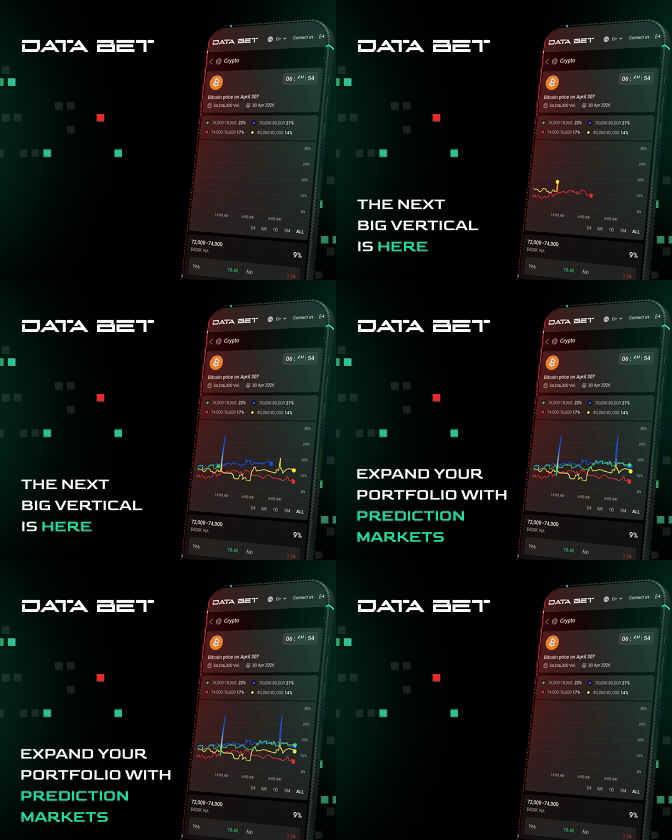
















Prediction markets spent years operating on the fringes of the gambling and financial ecosystem, largely confined to crypto-native communities, niche platforms, and regulatory grey areas. For much of that time, the mainstream iGaming industry observed from a distance, treating the vertical as an experimental concept rather than a serious market segment.
That perception has changed dramatically.
The growth of prediction markets over the past two years has been impossible to ignore. Kalshi alone reportedly processed $43 billion in trades during 2025, while monthly trading volumes surged from less than $100 million at the beginning of 2024 to more than $20 billion by early 2026. On Super Bowl Sunday 2026, a single platform facilitated $871 million in trading activity within 24 hours. At the same time, jurisdictions such as Gibraltar have begun issuing dedicated prediction market operator licenses, while B2B suppliers and infrastructure providers continue entering the space.
Prediction markets are no longer an emerging niche. They have evolved into a legitimate vertical with their own commercial momentum, user behavior, and operational demands. Most importantly, they are attracting a type of player that traditional acquisition funnels, retention systems, and platform strategies were never built to serve.
According to Turbo Stars, conversations around prediction markets are becoming increasingly common among operators across multiple jurisdictions. Yet despite the growing interest, there remains limited understanding of who these users actually are and what drives their engagement.
A Different Kind of Player
The prediction market audience does not align with the standard iGaming customer profile.
These users are highly competitive, information-driven, and deeply engaged with current events. Unlike the traditional casino or sportsbook customer seeking primarily entertainment, prediction market participants are motivated by analysis, opinion, and the desire to act on real-world developments.
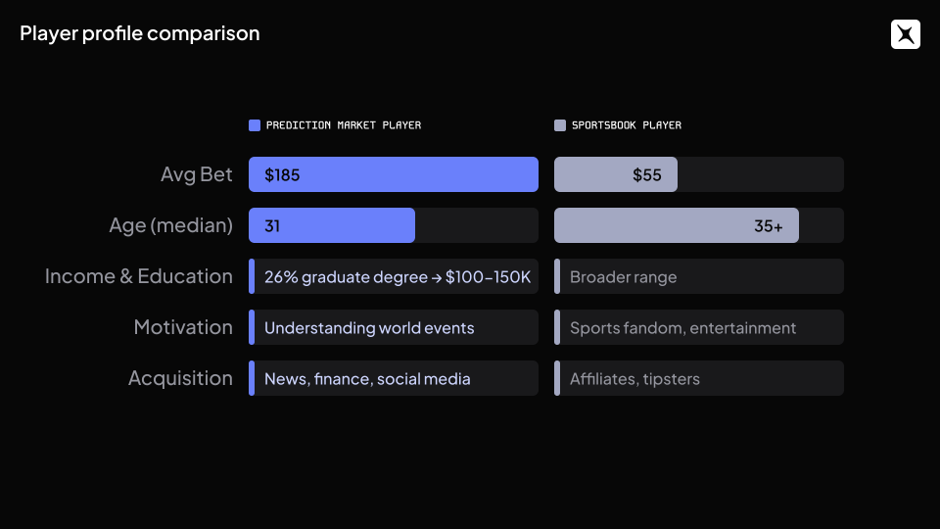
The dominant demographic falls within the 25 to 34 age range, predominantly male, with above-average levels of education and income. Research indicates that 26% hold graduate degrees, while nearly one-third report annual earnings between $100,000 and $150,000.
This is not a passive audience. These users actively follow geopolitics, economic trends, social developments, and financial news. They consume information in much the same way sports bettors analyze lineups and statistics. The difference is that, for prediction market players, the world itself becomes the betting board.
One of the sector’s greatest advantages has been accessibility. Prediction markets removed many of the barriers associated with traditional betting products. Users do not require deep sports knowledge or gambling experience. They simply need an informed opinion on an event already unfolding around them.
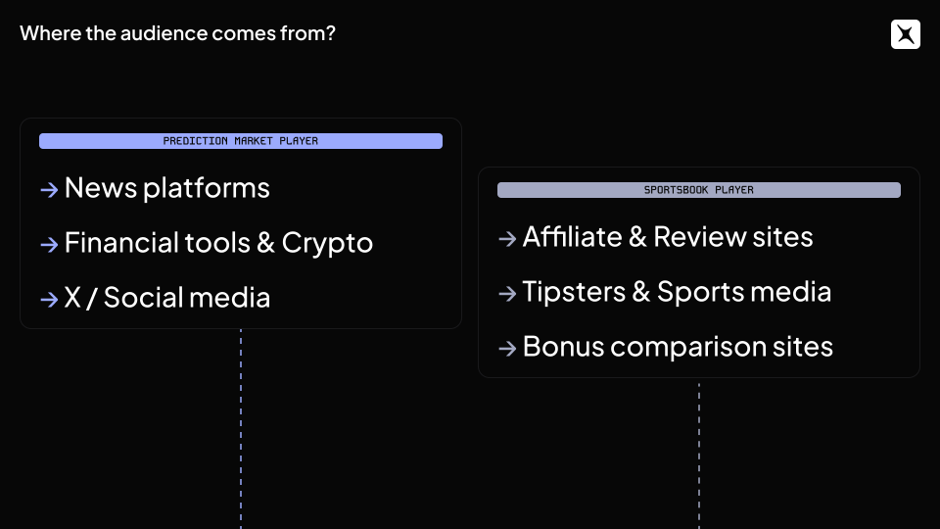
The acquisition ecosystem reflects this distinction. Traffic is driven through news platforms, financial applications, podcasts, creator content, and social media discussions rather than through traditional sportsbook affiliates or casino review websites. As a result, the conversion funnel looks fundamentally different from the infrastructure most operators currently rely on.
How They Actually Bet
User behavior within prediction markets also differs significantly from traditional sportsbook patterns.
The average prediction market wager is estimated at $185, substantially higher than the approximate $55 average sportsbook bet. The difference reflects not only a distinct product structure, but also a different psychological relationship with risk and participation.
Engagement frequency follows the same trend. Around 21% of users reportedly trade daily, while another 29% participate several times per week. This level of activity suggests routines built around news cycles, macroeconomic developments, elections, sporting narratives, and real-time information consumption rather than occasional recreational betting.
At the same time, trading volume remains heavily concentrated. Approximately 2% of users account for nearly 90% of overall activity, creating a familiar dynamic for operators accustomed to VIP-driven gaming ecosystems.
However, the profile of these high-value users is notably different from the traditional casino whale. Instead of players pursuing entertainment-driven high-risk sessions, prediction market power users are often approaching the product analytically, treating positions as informed theses tied to political, financial, or cultural outcomes.
Cross-Vertical Engagement
Several leading sportsbook operators have publicly stated that prediction markets are not significantly cannibalizing existing sportsbook revenue, and current data appears to support that position. Estimates suggest that only around 5% of legal sportsbook handle has migrated toward prediction market products.
Yet acquisition trends reveal a more important long-term shift.
Between September 2025 and February 2026, major sportsbook platforms experienced year-over-year declines in new app installations ranging from 13% to 18%. During the same period, Kalshi alone reportedly added 6.3 million users.
This suggests prediction markets are not necessarily replacing sportsbook betting behavior, but rather capturing the attention of a new generation of users before sportsbooks enter the consideration set at all.
Further analysis strengthens this distinction. Users who actively participate in both ecosystems tend to underperform on each platform compared to native users. In practice, the crossover audience does not fully behave like either a sportsbook bettor or a prediction market trader.
Structurally, these are two different user archetypes.
For operators, this should be viewed less as an immediate competitive threat and more as a strategic signal. A new category of player is entering the wider gaming ecosystem through entirely different channels, and the opportunity to build products specifically for that audience remains open.
What This Means for Operators
Prediction markets cannot simply be inserted into an existing sportsbook or casino roadmap without adaptation.
The player profile is different. The acquisition path is different. The engagement logic is different.
Traditional sportsbook retention mechanics, such as odds boosts or free bet campaigns, may not resonate with users who are engaging with geopolitical events, economic developments, or cultural narratives from an analytical perspective.
For operators exploring this vertical, success will likely depend on designing products specifically around the behaviors and expectations of this emerging audience rather than attempting to retrofit legacy engagement systems.
Understanding how these users think, consume information, and interact with platforms is no longer a secondary consideration. It is becoming a foundational requirement for any operator seeking relevance in the next phase of market evolution.
As prediction markets continue transitioning from experimental products into long-term strategic roadmap priorities, Turbo Stars believes the industry’s biggest challenge is no longer whether the vertical will grow, but whether operators are prepared for the player that comes with it.