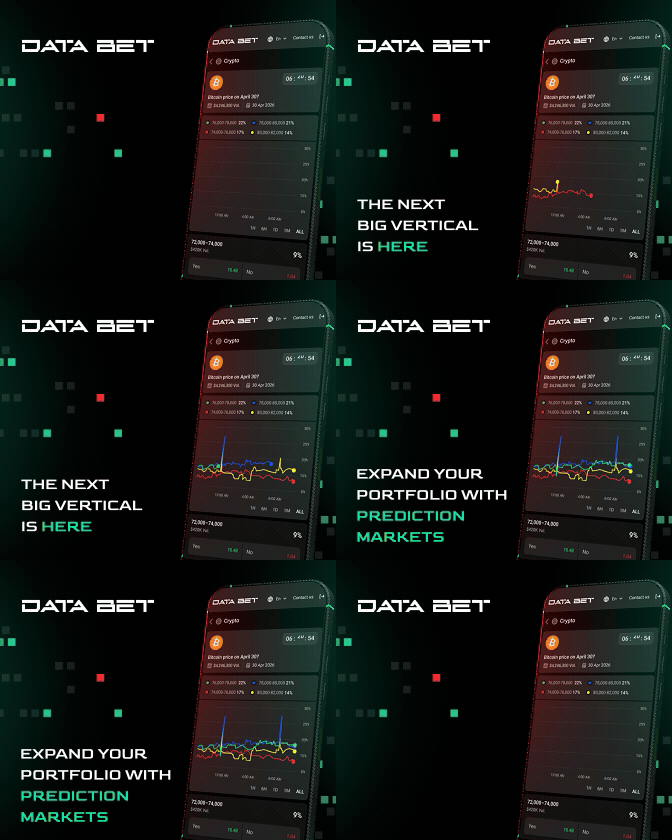











Operators entering prediction markets in 2026 are facing a question many are still unprepared for: which architecture to build on. The vertical itself is no longer in doubt. The real question is how to execute it.
Two architectures are competing for the same use case, and they are far from interchangeable. This decision shapes risk exposure, margin structure, operational requirements, and the type of player base a product can realistically sustain.
Turbo Stars approaches this as a strategic business decision driven by factors such as operator scale, traffic profile, regulatory footprint, internal capabilities, and long-term vision. The following elements are what ultimately define the answer.
Fixed-Odds
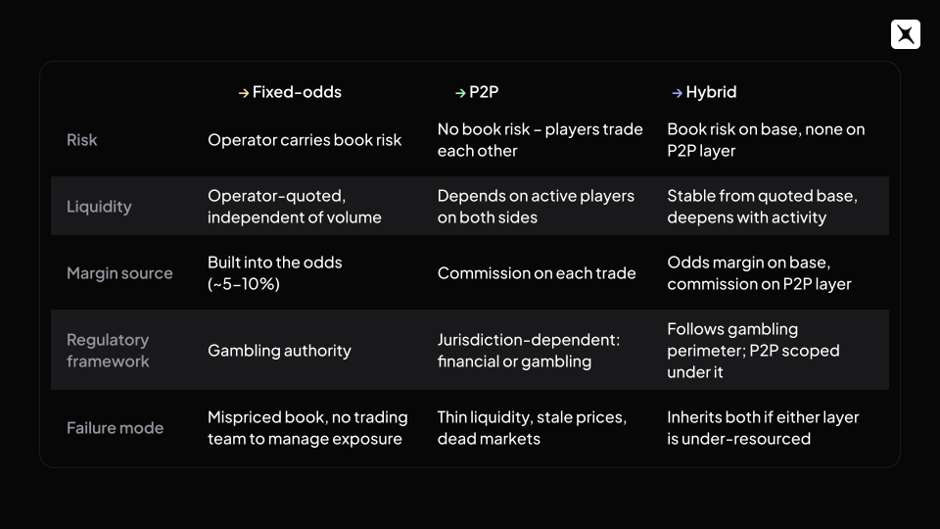
The fixed-odds model maps directly onto the traditional sportsbook structure. The operator sets the odds and takes the opposite side of the bet. Players wager on an outcome at predefined prices, while the operator carries the risk. The margin is embedded into the odds themselves, typically ranging between five and ten percent across balanced markets.
The infrastructure is equally familiar territory for sportsbook operators. Pricing logic, exposure management, settlement systems, and liability tracking all align naturally with existing trading operations.
From a regulatory standpoint, the business remains firmly within the gambling ecosystem. Licenses are issued by gambling authorities, alongside the standard obligations that follow: responsible gambling tools, KYC and AML frameworks adapted for betting activity, advertising restrictions, and taxation models designed around bookmaker revenue.
In March 2026, Gibraltar issued its first dedicated prediction market operator license. The license was granted to Predict Street Ltd as a betting intermediary under the 2005 Gambling Act. Jurisdictions taking the sector seriously are increasingly placing prediction markets within existing gambling frameworks.
P2P
The peer-to-peer model operates more like an exchange. Two players take opposite positions within a market, the platform matches them, and the operator earns a commission on each trade. The operator itself carries no risk.
There is no built-in margin within the odds, since pricing is entirely determined by participants buying and selling contracts as probabilities shift in real time.
This is the architecture powering platforms such as Kalshi and Polymarket. In this model, the size and activity of the player base become everything. Markets only function efficiently when there is enough liquidity on both sides to keep prices moving and spreads competitive.
Legally, the classification depends entirely on the jurisdiction rather than the mechanics. In the United States, Kalshi operates under the Commodity Futures Trading Commission as a federally regulated event-contract exchange, meaning the platform is treated as financial infrastructure rather than gambling. In the United Kingdom, however, the exact same mechanics fall under the Gambling Commission, where prediction markets are classified as betting intermediaries.
Choosing Between Them
Each architecture succeeds within its own lane. The decision depends less on personal preference and more on what the operator already has in place — and what can realistically be built before launch.
Fixed-odds is best suited for operators with sportsbook DNA. The infrastructure is already familiar, the regulatory perimeter is mapped out, and the model can perform at any traffic scale. However, it requires a strong trading team capable of pricing markets, managing exposure, and pulling odds before the book becomes vulnerable. Without those capabilities, margins can quickly disappear due to unforeseen market events.
P2P, on the other hand, is more suitable for operators that already possess an active user base and the ability to continue scaling it. The model requires liquidity from day one, with users actively trading both sides of every market. Kalshi and Polymarket spent years building that audience through regulatory positioning, free-market periods, and major headline-driven events. Operators entering the space today without that runway often end up with stale pricing, wide spreads, and markets that fail to generate visible activity.
What Does This Mean?
For new operators entering the prediction market vertical in 2026 without a proven polybetting playbook, fixed-odds represents the most pragmatic starting point — though not necessarily the final destination.
Hybrid mechanics allow operators to combine fixed-odds at any scale while selectively introducing P2P experiences in markets with deeper player liquidity. Each event can support both quoted markets and peer-traded markets simultaneously. This creates stability while players gradually become familiar with P2P mechanics, helping build demand, liquidity, and long-term adoption for a potential full transition in the future.
Within either model, the overall player experience can still be balanced across different user segments through the tools each architecture enables.
What Actually Drives the Answer
The architecture decision is not a one-time technical choice. It becomes the foundation that determines how the product scales, which users it retains, and under which regulatory framework the vertical will operate throughout its lifecycle.
The mechanics themselves are simpler than they appear. The business implications are not.
Turbo Stars approaches this decision as a business strategy rather than purely a technical matter, evaluating operator resources, market positioning, and the long-term direction the vertical is expected to evolve toward.
The architecture question is ultimately the first one worth answering before anything else gets built.