









Every iGaming brand runs on traffic. The people who generate it, move it, and price it are not just vendors. They are a fundamental part of the industry’s lifecycle. Without affiliates, most operators simply do not have a business.
But there is a question worth asking: what does affiliate traffic actually look like from the other side of the deal?
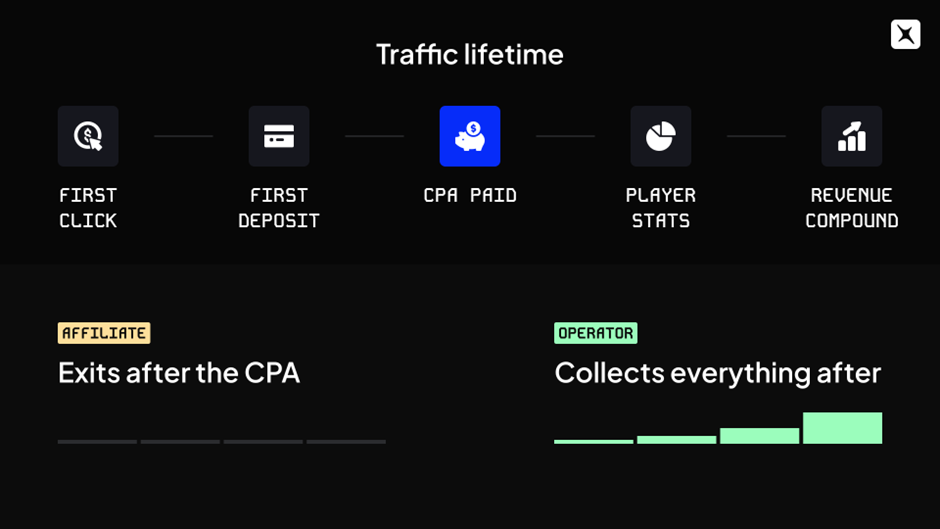
Working with operators across high-value markets, Turbo Stars sees traffic across its full lifecycle, from the first click to years of recurring deposits. From that perspective, one thing becomes clear: the CPA payout is not the moment of value. It is closer to the beginning of it.
Understanding what that means for the affiliate business model, and what it could mean in the future, is the purpose of this analysis.
The SEO affiliate ceiling
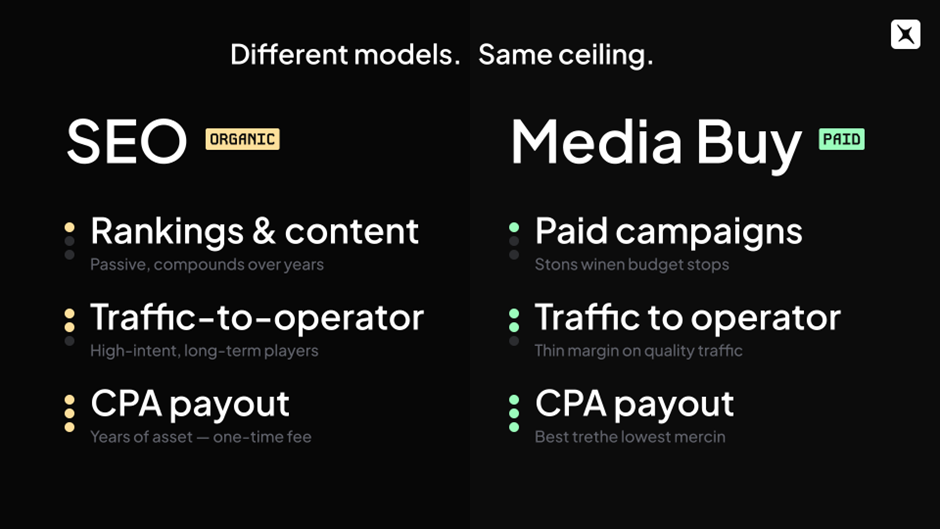
An SEO affiliate business is, at its core, an asset. Rankings take years to build, content compounds over time, and a well-structured network can deliver consistent high-intent traffic with a strong share of high-value players.
However, growth does not eliminate the structural challenge of being an intermediary.
When operator demand drops, the affiliate absorbs the impact directly. Marketing budgets are reduced, markets shift, and regulatory pressure increases.
A recent example illustrates this dynamic. Better Collective, one of the world’s largest affiliate groups with €371 million in revenue, announced layoffs of more than 300 employees in late 2024 after operators reduced marketing activity in key markets.
The traffic did not disappear. The demand did.
Their strategic response was logical: expand into new markets, acquire more assets, and broaden their footprint. That strategy works, up to a point.
But there is another way to look at it. If traffic is the real asset, the question is not only how to generate more of it. It is whether the full value of existing traffic is being captured.
The mediabuy margin trap
Where SEO networks generate traffic passively, mediabuy operations only run while the advertising budget runs. No budget means no traffic. No traffic means no revenue.
This creates a different type of operational pressure and amplifies the margin challenge.
Margins on quality traffic are often thin because acquisition costs consume most of the CPA payout. Incentivized traffic is cheaper and can deliver margins between 50 and 60 percent.
However, operators do not buy this type of traffic indefinitely. Retention metrics reveal its limitations quickly.
As a result, the model often becomes a hybrid: quality traffic to maintain operator relationships and incentivized traffic to maintain profitability.
But maintaining that balance becomes harder every quarter. Acquisition costs rise faster than CPA rates, margins compress, and reliance on incentivized traffic increases.
Ironically, the traffic that generates only a 5 to 10 percent margin under CPA deals is often the traffic with the best retention and redeposit performance over time.
The issue is not traffic quality. The issue is monetization.
What CPA actually buys
Both SEO and mediabuy models share the same economic dynamic.
SEO affiliates trade a long-term asset for a one-time payout. Media buyers sell their best traffic at the lowest margin.
In both cases, the transaction ends at the moment of the first deposit.
Everything that happens after that belongs to the operator.
And that “after” is where the real economics of iGaming exist.
Players who make their first deposit rarely stop there. They return. Sometimes for months. Sometimes for years. Each session and redeposit builds a revenue relationship that looks nothing like the original CPA fee.
Operators who pay CPA fully understand this.
Affiliates who recognize it as well are in a position to rethink the model.
Unlocking lifetime value
The alternative approach is simple: send the same traffic to your own brand instead of selling it.
In this model, acquisition becomes an internal transfer. The only cost is what it actually took to generate the player, not the price another operator was willing to pay.
Instead of a one-time CPA payment, the affiliate captures the full lifetime revenue generated by the player.
A more accessible path than it used to be
At first glance, moving from affiliate to operator may appear complex. Today, however, the operational side is far more accessible than it once was.
A platform provider can handle the infrastructure including payments, compliance, engagement tools, retention features, and technical integrations.
This allows affiliates to focus on what they already do best: traffic generation and brand building.
For affiliates who have spent years mastering acquisition strategies, this model offers a path toward a different scale of business, where revenue compounds over time instead of resetting with every CPA deal.
Ultimately, the decision comes down to two variables: the willingness to change and the appetite to operate beyond the familiar affiliate model.
The economics behind the shift are already visible in the numbers.
Turbo Stars is a B2B iGaming platform and sportsbook provider designed for operators entering new markets, scaling existing brands, and launching new ventures. The solution offers fast deployment, native sportsbook integration, and the full infrastructure affiliates need to run their own brand without building everything from scratch.