













An EvenBet Gaming case study shows how novelty, player-focused adaptation and smart cross-selling can generate additional revenue without transforming the core poker experience.
Adding casino content to a poker room may appear to be a straightforward strategy. In practice, however, the success of a new launch depends on much more than simply adding another game to the platform.
That is the conclusion behind a recent case analysed by EvenBet Gaming, a provider of online poker solutions, following the launch of a casino game within a medium-sized poker room. Although the operator cannot be identified due to a non-disclosure agreement, the results provide valuable insights for poker operators looking to diversify revenue through complementary gaming content.
The poker room involved in the case serves a largely traditional, poker-focused audience. Its interface and feature set remain relatively close to the platform’s standard configuration, while players are generally not accustomed to extensive gamification or frequent product changes.
That made the introduction of Cowboy Hold’em particularly interesting.
The game was launched as an additional side game within the poker experience, with the operator agreeing to test it as a new revenue opportunity.
There was no major marketing campaign behind the launch. Promotion consisted of a small banner within the poker client.
Despite this, the result was significant: Cowboy Hold’em quickly became a meaningful additional revenue stream and ultimately contributed to an increase of around 10% in the room’s total revenue.
According to EvenBet Gaming, the result was not simply a matter of luck. Five key factors helped explain why the launch worked.
1. Novelty creates curiosity
Introducing something new into a poker room can naturally attract attention, particularly when new releases are relatively uncommon.
A traditional audience does not necessarily mean an audience that is resistant to change. Poker players may have established habits while still being curious when something genuinely new appears within an environment they already know.
In this case, no aggressive promotional strategy was required. A simple announcement within the poker client was enough to create awareness and encourage players to try the game.
The lesson is straightforward: novelty can be a powerful engagement tool when introduced naturally and without disrupting the core player experience.
2. The right game matters
Not every casino game is equally suited to a poker audience.
One of Cowboy Hold’em’s main advantages is that its mechanics feel familiar to poker players. They already understand cards, combinations and much of the underlying logic of the experience.
That significantly lowers the barrier to entry.
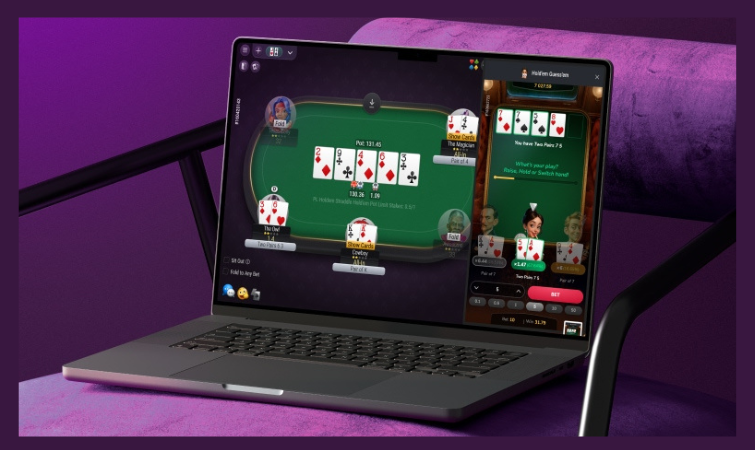
Cowboy Hold’em combines elements of Texas Hold’em with roulette-style betting, built around a showdown between the Cowboy and the Bull.
The pace of the game is also important. Its fast format allows players to enjoy several rounds during natural pauses in a poker session without having to completely leave the core poker experience.
For EvenBet Gaming, this represents an important principle of effective cross-selling: the goal is not to ask players to switch to a completely different product, but to offer complementary entertainment built around behaviours and mechanics they already understand.
3. Localization goes beyond translation
Localization was another important element in the case.
The operator decided not to launch Cowboy Hold’em under its original name. Instead, the game was renamed using a reference to another title already popular in the region, with relatively similar mechanics.
This helped reduce the distance between something unfamiliar and something players already recognised.
Even before opening the game, the name provided players with a basic reference for the type of experience they could expect. That connection helped create familiarity and encouraged trial.
The example highlights an important point: effective localization is not simply about translating an interface. It is also about understanding the habits, cultural references and expectations of a particular player audience.
4. Product fine-tuning can make the difference
Choosing the right game is only the beginning.
Following the launch, the operator closely monitored how players interacted with Cowboy Hold’em and began adjusting different settings.
Rather than simply relying on the initial configuration, the team tested different parameters, analysed player behaviour and refined the product until they found a setup that better suited their audience.
This optimisation process can be particularly important for casino products integrated into poker platforms.
The same game can perform very differently depending on how it is configured and presented to a specific player base.
In this case, the operator did not simply launch the product and wait for the numbers. Continuous monitoring and optimisation became an important part of the process.
5. A healthy player base is essential
Finally, there is one factor no new game can replace: an active player community.
Although the poker room involved in the case is relatively small, it has an established player base and a healthy poker ecosystem, with steady growth over the years.
This provided the right conditions for the new product to find an audience.
Cowboy Hold’em did not have to create demand from scratch. It was introduced to a community that was already active, engaged and comfortable with the platform.
For EvenBet Gaming, this is particularly important: entertainment features, gamification and additional gaming content tend to perform best when built on top of an established player ecosystem.
Growth without reinventing the poker room
The case demonstrates that adding casino content to a poker room does not necessarily require a complete transformation of the platform.
There was no major redesign, large-scale promotional campaign or complex acquisition strategy behind the result.
Instead, the outcome came from a combination of the right game, the right audience, smart localization, continuous optimisation and a healthy existing player base.
From EvenBet Gaming’s perspective, the experience offers an important takeaway for operators: before looking for entirely new ways to attract players, it can be more effective to understand the ecosystem that already exists and identify products capable of complementing the audience’s existing behaviours.
In this case, a revenue increase of around 10% did not require reinventing the poker room. It required understanding what was already working and adding the right product at the right time.