
















Risk management continues to suffer from a perception gap within the industry. In operator discussions, it is typically defined by what it prevents: excessive exposure, sharp players, volatile markets, margin leakage, and losses that must be contained. The language surrounding it is almost always defensive — limit, restrict, control, block.
However, that framing overlooks a much broader reality.
The same decisions that protect operators from downside also determine how much margin a business can capture. They influence which odds feeds are selected, which markets are prioritised, how limits are applied, and which product mechanics drive betting behaviour.
Drawing on its work with operators across multiple markets, Turbo Stars consistently identifies the same pattern: risk management is still treated as a back-office safeguard, despite its direct impact on product performance and revenue.
That definition is no longer enough.
An incomplete definition
Traditionally, operators rely on a familiar set of tools: bet limits, market suspension, dynamic odds adjustments, player profiling, and liability tracking. While effective, each of these tools carries second-order effects that extend beyond loss prevention.
A bet limit does more than cap exposure to sharp players — it signals that they are not welcome, often leading to churn. Suspending a volatile market does more than protect against mispricing — it removes a product the player intended to engage with. Adjusting odds in real time does more than rebalance the book — it reshapes the betting experience itself.
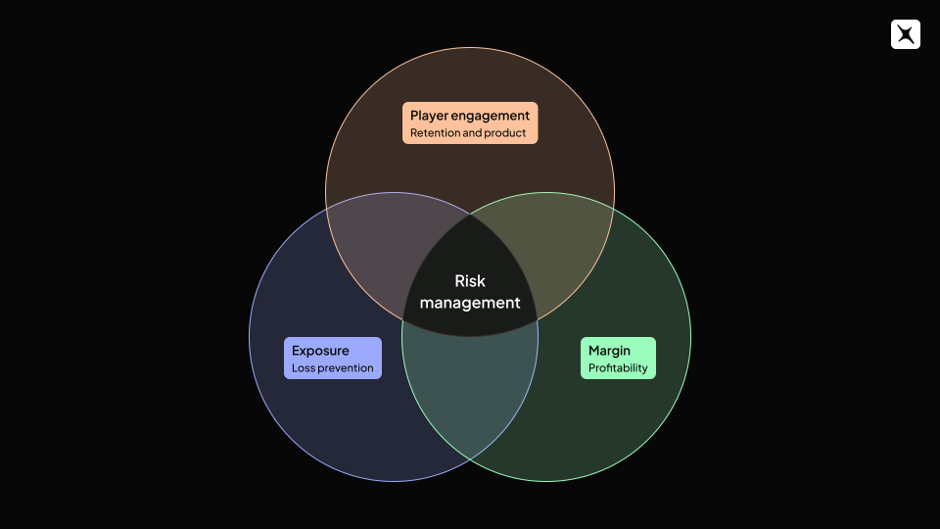
Every risk decision is simultaneously a margin decision and an engagement decision. These elements are not independent.
Where risk, margin, and engagement converge
When risk management is viewed beyond loss prevention, three operational levers come into focus, each carrying both margin and engagement implications.
The first is odds sourcing. A poor or slow odds feed creates a dual risk: exposure to pricing inefficiencies and reduced competitiveness for players who compare prices across platforms. A more accurate feed protects margin while improving retention through a more reliable product experience.
The second is market selection. Restricting volatile markets reduces exposure but also reshapes the product offering. Remove too many markets and the platform becomes less attractive; keep too many open and margin erodes. Leading operators are not choosing between protection and product — they are calibrating which markets deliver sustainable margin while maintaining player appeal.
The third is product mechanics. A single bet and a multi-leg bet builder are fundamentally different products. Each additional selection compounds probability, alters the edge, and creates a distinct margin profile. At the same time, these mechanics drive engagement. Bet builders and live accumulators stand out because they create a more active, immersive experience. Operators leveraging them are not only structuring higher margins, but also building formats that players return to.
Remove any one of these levers and the outcome is the same: margin contracts, engagement declines, or both. Combine them deliberately and the difference becomes structural — reflected in margin, but built into the product itself.
Risk management is the product
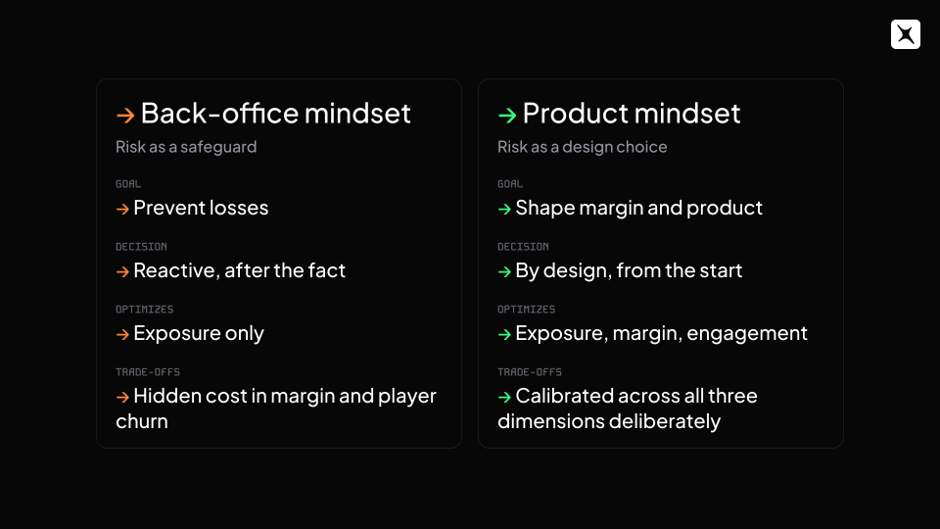
The question is not whether a platform manages risk — technically, all platforms do. The real question is whether risk management is treated as a product decision or as something applied after the product is built.
When treated as a back-office function, it optimises one variable while quietly damaging the others. When embedded into the product, it aligns risk, margin, and engagement into a unified system.
The result is clear: stronger margins, higher player retention, and platforms that operate as integrated systems rather than fragmented functions.
From this perspective, Turbo Stars approaches platform design. Pricing, trading, content prioritisation, and product mechanics are not separate silos, but part of the same product architecture — and the operators who adopt this mindset are the ones whose performance reflects it.