






Artificial intelligence has become a powerful accelerator in game development. Within the iGaming industry, AI assisted tools help studios reduce costs, shorten production cycles, and bring familiar, polished products to market faster than ever before. At the same time, these technologies have amplified a long standing industry issue: the proliferation of look alike games that closely replicate the style, mechanics, and overall feel of successful titles without directly copying them.
This dual nature of AI has created a new risk landscape. While AI driven efficiency can offer a strong competitive advantage, it also blurs the boundary between inspiration and imitation. As a result, operators and suppliers face growing legal, regulatory, and commercial uncertainty, particularly in a highly standardised and tightly regulated sector such as iGaming.
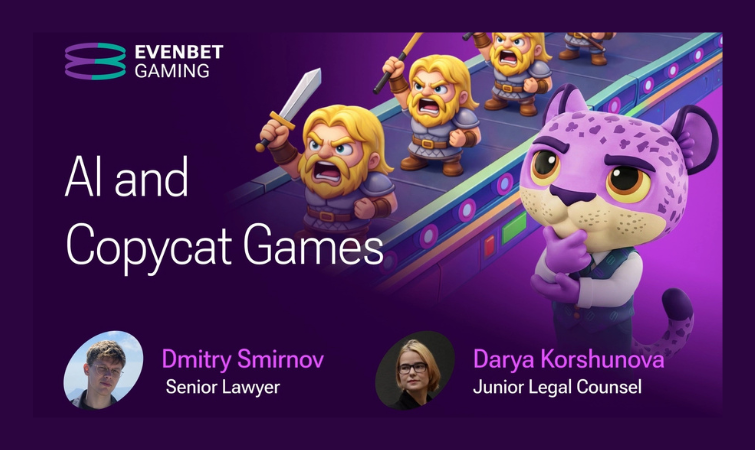
In this article by EvenBet Gaming, Dmitry Smirnov, Senior Lawyer, and Darya Korshunova, Junior Legal Counsel, examine the issue from a legal standpoint. They explore how AI generated and AI assisted game assets are treated under existing copyright and competition law frameworks, and outline practical considerations to help iGaming businesses manage this evolving area while avoiding costly legal and regulatory consequences.
AI Assisted Game Development and the Look Alike Challenge
Artificial intelligence has evolved from an experimental novelty into a mainstream production tool. Today, AI assisted workflows are widely used for concept art, animations, sound effects, user interface mock ups, balancing simulations, localisation, and dialogue generation. In iGaming, where speed to market and cost efficiency are critical, small teams can now create visually polished interfaces and familiar mechanics in a matter of weeks rather than months.
At the same time, AI has scaled up the long standing issue of cloned or highly similar games. A look alike game does not involve direct copying of code or assets, but instead closely mimics the visual style, user experience, mechanics, and overall feel of a successful product. With generative AI, this form of imitation has become faster, cheaper, and more scalable than ever before.
The iGaming sector is particularly vulnerable. Poker tables, card designs, slot interfaces, animations, and UX flows are already highly standardised. Regulators expect consistency, and players gravitate toward experiences that feel familiar and trustworthy. AI systems trained on existing games can generate assets that appear almost indistinguishable from established brands without copying any individual element verbatim.
This raises a critical legal question: when is AI generated content merely inspired by existing games, and when does it become too similar? Current copyright and competition laws were not designed to address AI systems that blend styles at scale, placing much of this activity in a legal grey zone with significant commercial risk.
Human Authorship and Copyright Uncertainty
One of the central legal challenges surrounding AI generated content is authorship.
Under European Union copyright law, protection requires that a work be the author’s own intellectual creation, reflecting human creativity and free choice. Fully automated or mechanical outputs generally fail to meet this standard. Where AI systems generate content without identifiable human creative decisions, copyright protection may not arise at all. This does not mean the content is freely usable in practice, but rather that ownership and enforceability become unclear.
Malta, as a key iGaming jurisdiction, follows the EU framework. From a licensing and compliance perspective, this creates practical difficulties. Operators are expected to demonstrate ownership or licensed rights in their game assets. If significant elements of a game are AI generated with unclear authorship, regulators may question whether the operator genuinely controls and can protect its product.
The United Kingdom takes a different approach under Section 9(3) of the Copyright, Designs and Patents Act, which assigns authorship of computer generated works to the person who made the arrangements necessary for their creation. However, this provision predates modern generative AI and has seen limited judicial interpretation. It remains unclear how much human involvement is required, how arrangements should be defined in complex AI pipelines, and whether the provision remains fit for purpose.
In the United States, the position is more restrictive. Copyright protection requires human authorship, as confirmed in recent cases and reinforced by guidance from the US Copyright Office. Works created entirely by AI without sufficient human creative control are not registrable, although human selection, arrangement, or modification of AI outputs may still attract protection.
Why This Creates Commercial Risk
Across jurisdictions, autonomous AI outputs often fail to attract copyright protection. Rather than providing legal certainty, this creates exposure. Unprotected assets may be reused or closely imitated by competitors with relatively low legal risk, while at the same time operators may still face claims alleging infringement, unfair competition, or consumer confusion.
This asymmetry is commercially dangerous. The lack of predictable legal outcomes makes risk assessment difficult, particularly in regulated markets where compliance expectations are high.
AI as a Tool Versus an Autonomous Creator
Regulators and courts increasingly focus on the distinction between AI used as a tool and AI acting as an autonomous creative entity. Where humans retain control over creative decisions, copyright protection is more likely. Where AI operates with minimal human intervention, attribution becomes problematic.
In practice, drawing this line is difficult. Questions arise around whether detailed prompting constitutes creative authorship, whether selecting one output from many reflects creative choice, and how much post generation editing is sufficient. For iGaming studios, documenting human involvement is becoming essential from both a copyright and regulatory compliance perspective.
Style, Market Impact, and Regulatory Attention
Visual style is a powerful commercial asset in iGaming. Players associate familiar design languages with trust, fairness, and quality. However, style itself is rarely protected by copyright, which covers expression but not ideas, systems, or stylistic approaches.
This creates a paradox. AI systems can reproduce the most commercially valuable aspects of a game’s identity without infringing protected elements. As a result, contract law, including EULAs and terms of service, has become one of the strongest available tools to restrict scraping, training, or reuse of assets, despite its limitations in enforcement and cross border reach.
Regulatory and platform intervention is also increasing. In regulated gaming environments, issues such as consumer confusion, brand dilution, and unfair competition may attract scrutiny even where copyright claims fail. Platform policies, such as the reported rejection of AI generated assets by major distribution platforms when ownership cannot be clearly demonstrated, reflect this growing sensitivity.
Practical Takeaways for iGaming Businesses
The analysis from EvenBet Gaming highlights that AI will not eliminate cloned or look alike games. However, disciplined legal and operational strategies can significantly reduce risk and preserve long term value.
Key practical considerations include using AI as a tool rather than an autonomous creator, ensuring that human creative decisions are made and documented, implementing strong contractual controls with suppliers and partners, adopting conservative compliance and disclosure standards, and establishing internal AI governance frameworks.
Crucially, businesses should avoid relying on style alone as a protective asset. While style is commercially powerful, it is legally fragile. Investing in distinctive combinations of visuals, audio cues, pacing, and interaction logic offers stronger protection than any single stylistic feature.
In an increasingly homogenised market, the winners will not be those who imitate the fastest, but those who combine speed with defensible originality and regulatory credibility.
Source: https://evenbetgaming.com/blog/articles/look-alike-games-and-the-problem-of-ai-remixes-in-igaming/