
















Industry insight by Turbo Stars
In iGaming, retention strategies are typically built around bonuses, personalized offers, and loyalty programs. Yet one critical element rarely takes center stage: payment infrastructure.
Often treated as a technical layer that simply needs to “work,” payments are, from the player’s perspective, one of the most personal and decisive aspects of the entire experience. It’s not just about the games or promotions — it’s about whether a deposit goes through and whether a withdrawal arrives on time.
These moments are not perceived as infrastructure. They are moments of trust.
Where players are actually lost
Player interaction with payment systems is concentrated in two key moments: deposits and withdrawals. What happens at these points directly shapes retention.
The data is clear:
- 40% of players do not return after a failed deposit
- 27% of churned players cite deposit or withdrawal issues as the main reason for leaving
- Withdrawal speed ranks as the number one loyalty factor, ahead of bonuses and game selection
This highlights that financial experience is not secondary — it is foundational.
Deposits: the first breaking point
Deposits represent the moment a player commits real money. Yet, it is also where many journeys end prematurely.
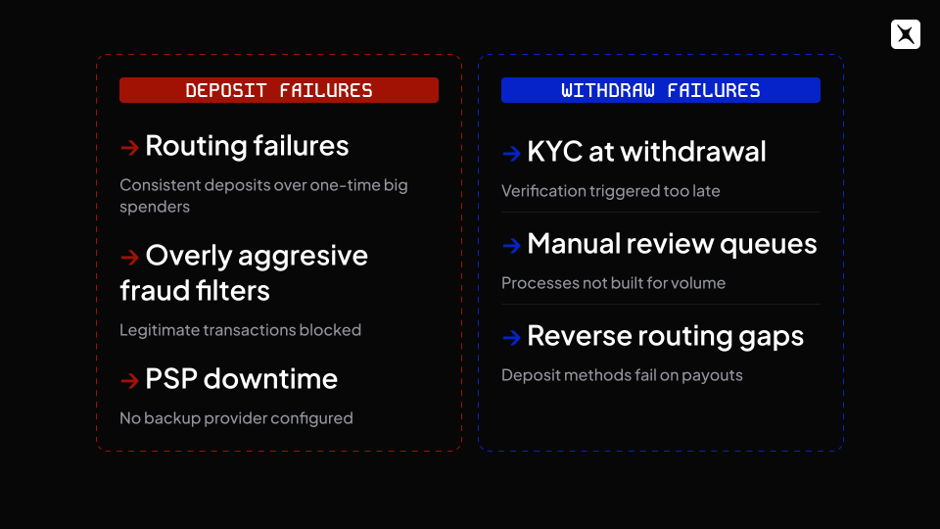
Approval rates in iGaming range from 75% to 95%, depending on payment providers and routing configurations. This gap means a significant number of players ready to engage are turned away due to technical failures, downtime, or overly strict fraud filters — not because of insufficient funds.
User experience plays a major role as well. Around 32% of players abandon a platform if the deposit process is slow or complicated. Additionally, the absence of preferred local payment methods can result in the loss of entire user segments.
Withdrawals: where trust is defined
If deposits are the entry point, withdrawals are the ultimate test of trust.
When withdrawals are fast and seamless, loyalty increases significantly. When they are not, the impact is immediate and negative. Players waiting for their funds are not thinking about their next session.
In many cases, the issue is not policy but infrastructure. KYC checks triggered at withdrawal instead of registration, manual review processes that do not scale, and payment flows that are not designed for reverse transactions all create unnecessary friction.
In markets where same-day payouts are expected, multi-day processing times become a critical pain point.
Three priorities for payment-driven retention
According to Turbo Stars, operators should focus on three key areas:
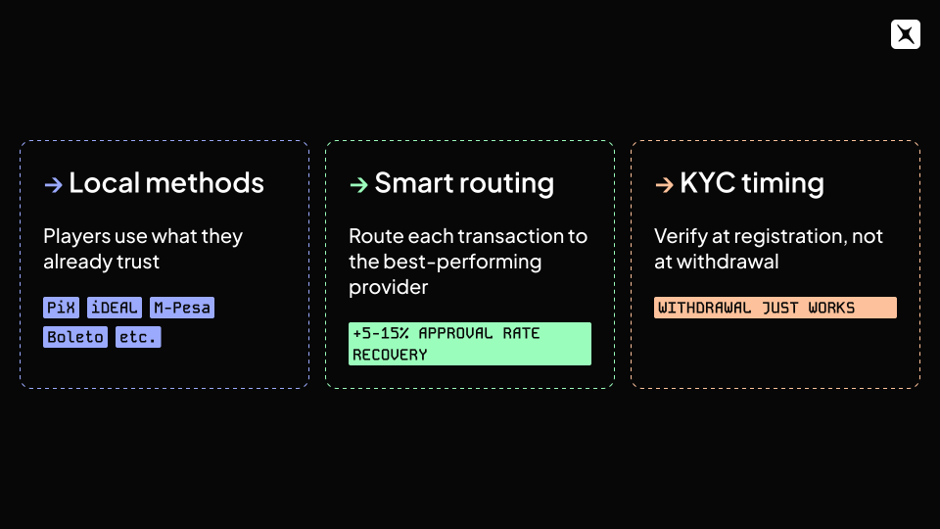
1. Local payment methods
Players prefer familiar systems. Options such as PIX, iDEAL, and M-Pesa are not optional — they are essential in their respective markets.
2. Smart routing
Many failed deposits are not caused by the player, but by how transactions are routed. Smart routing systems that automatically redirect failed transactions to alternative providers can recover a significant portion of lost payments without user friction.
3. KYC timing
Moving identity verification to the registration stage eliminates one of the biggest friction points. The result is a smoother withdrawal experience aligned with player expectations.
Beyond technology: a matter of trust
Retention in iGaming is often discussed in terms of content and promotions. However, in an industry where entertainment is directly tied to money, there is a quieter but decisive dimension: financial trust.
A player who deposits smoothly and withdraws without delay is not evaluating the platform — they are simply playing.
From this perspective, payment infrastructure is no longer a backend function. It becomes a strategic touchpoint for both operators and providers, with the power to determine whether a player stays or leaves.