












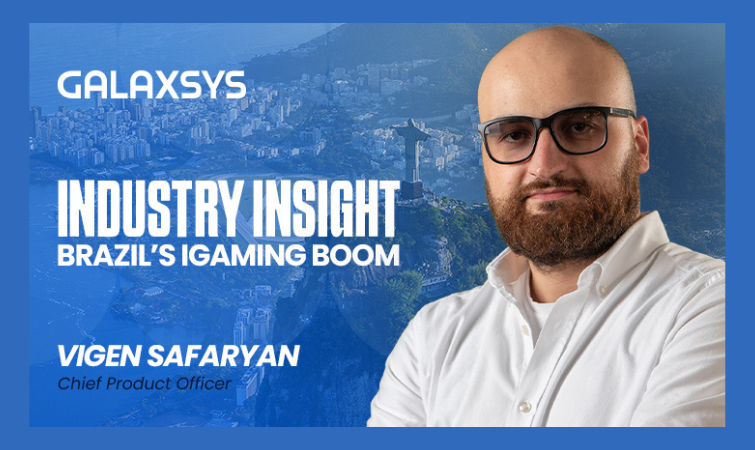
Industry insight by Vigen Safaryan, Chief Product Officer at Galaxsys
Brazil has emerged as the most talked-about market in global iGaming. However, beyond rapid growth, what is truly taking place is a structural shift in how operators and game studios approach international expansion.
For years, Latin America was seen as a region full of potential. Today, Brazil is turning that potential into measurable reality, driven by regulation and the influx of millions of players into the ecosystem. The market is no longer a question mark — it is a strategic priority.
From grey market to global contender
Brazil’s regulatory transformation stands as one of the most significant industry developments in recent years. The implementation of Law 14.790 in 2023, followed by the rollout of federal licensing in 2025, has turned the country into a structured and highly regulated market.
Operators are now required to make substantial investments, establish a local presence, and comply with strict player verification processes, including CPF registration and real-time transaction monitoring.
“Brazil didn’t just regulate the market, it elevated it. The bar is now significantly higher, and that benefits everyone,” said Vigen Safaryan.
Scale as the defining factor
With over 213 million people, Brazil is the largest economy in Latin America. In 2025, gross gaming revenue reached approximately R$37 billion, with around 25 million players engaging on regulated platforms.
This scale reshapes product strategy. Rather than targeting high spenders, companies must design for mass audiences, prioritizing accessibility, retention, and ease of use.
Mobile-first reality
Brazilian players are overwhelmingly mobile-first, with most accessing platforms through mid- to low-range Android devices. This creates specific technical challenges for game developers.
“Performance is everything. If a game doesn’t load quickly or run smoothly on a basic device, the player is lost before the experience even begins,” Safaryan noted.
In this environment, simplicity, speed, and reliability outweigh complex graphics or mechanics.
Culture as a driver of engagement
Local culture plays a critical role in player engagement. While online slots remain dominant, fast-paced formats such as crash, plinko, and mines are gaining traction due to their immediacy.
Football and cultural elements like Carnival significantly enhance engagement, reinforcing that localization goes far beyond translation — it is a design philosophy.
Partnerships as a gateway to market entry
Regulatory and operational requirements make local partnerships essential. Working with established operators not only facilitates compliance but also accelerates access to player bases.
Safaryan emphasized the importance of on-the-ground expertise to avoid assumptions in such a dynamic market.
A market that rewards commitment
Brazil’s iGaming boom is not a temporary trend but a long-term structural shift. With billions in revenue, tens of millions of players, and an evolving regulatory framework, the market rewards companies willing to invest in localization, performance, compliance, and cultural understanding.
“Brazil rewards those who respect its uniqueness. It’s not about entering the market — it’s about becoming part of it,” Safaryan concluded.