














Until recently, fiat was the default for most iGaming platforms and, for most players, it still is. However, a growing share of users now arrives with a different starting point: crypto wallets, more speculative financial habits, and a set of expectations that traditional payment infrastructure was never designed to meet.
This is not a story about payment methods, but about a distinct audience with its own psychology, spending patterns, and expectations. It is a profile that already exists within gambling platforms or is actively migrating toward those that better fit its needs.
From its experience working with operators across multiple markets, Turbo Stars identifies the crypto bettor as one of the most underexplored high-value segments in today’s iGaming landscape. Here is what data and operator insights reveal about who this player really is.
Who They Actually Are
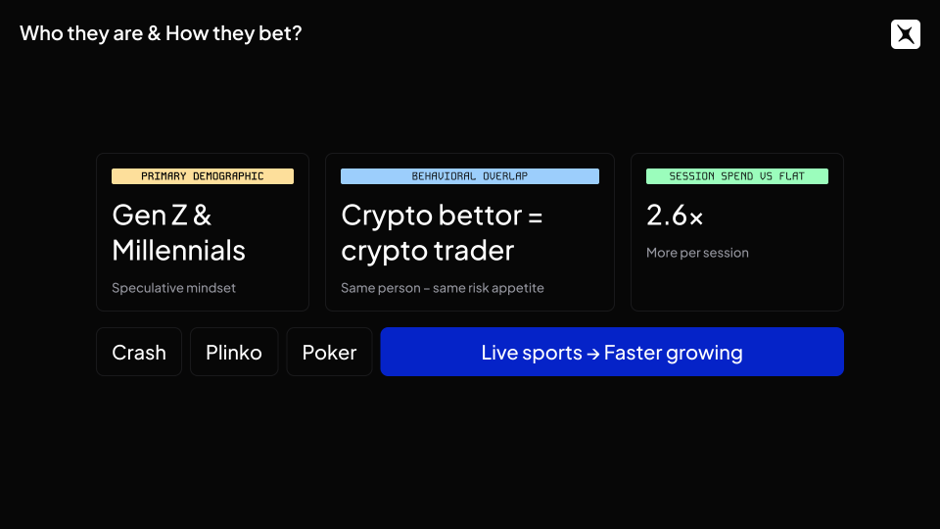
Crypto bettors tend to be younger, predominantly from Gen Z and Millennial demographics. However, demographics alone do not define this player.
The most revealing trait is behavioral: these are users accustomed to trading volatile assets, thinking in terms of risk and reward, and making financial decisions without relying on institutional intermediaries. In many cases, the crypto bettor and the crypto trader are the same individual.
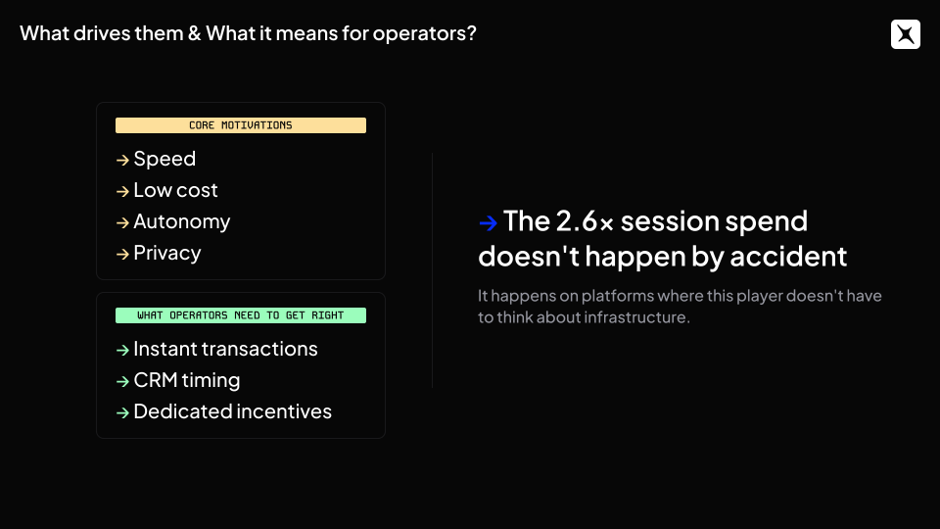
This distinction matters. These players are not simply looking for a safer way to deposit. Speed, autonomy, and the absence of intermediaries are not preferences, but baseline expectations.
How They Actually Bet
Crypto bettors do not behave like traditional casino players. Crypto bets exceeded $26 billion in Q1 2025 alone, nearly doubling the volume recorded in the same period of 2024. Once these users land on a platform, the data becomes even more compelling: crypto users spend on average 2.6 times more per session than fiat users.
This audience has also shifted away from passive formats toward experiences that reward risk tolerance and fast decision-making, such as crash games, plinko, poker, and live sports betting. In this context, sports betting is currently the fastest-growing segment among crypto gamblers.
Timing is another key factor. When crypto markets rise, user activity increases, and that momentum translates directly onto gaming platforms. Activity spikes are not random, but often reflect broader market movements.
What Actually Drives Them
Anonymity tends to receive the most attention, but it is not the primary driver.
Speed plays a more critical role. In environments such as live betting, where odds shift in real time, transaction speed can determine whether a bet is placed or missed. Traditional banking operates under a different logic, with processes, verification steps, and delays. Crypto does not. Delays in deposits or withdrawals do not just create friction; they can break the entire user session.
Cost follows the same principle. Every intermediary removed leaves more money available for play. Credit card fees typically range from 2.5% to 3.5% per transaction, while crypto reduces that cost to near zero. On platforms processing hundreds of microtransactions daily, this difference scales quickly.
Privacy sits above all of this, not as an added feature, but as an inherent value. Crypto transactions do not include personal data and are not tied to bank accounts or credit histories. For a generation raised in the digital economy, this is the baseline.
What This Means for Operators
The competitive response to this segment is already visible. Many operators have introduced deposit bonuses, cashback, and loyalty programs tailored specifically to crypto users, separate from traditional promotions and aligned with their actual behavior.
Retention mechanisms are also evolving. Blockchain-based loyalty programs, including NFT rewards and on-chain cashback, have demonstrated meaningful retention improvements on platforms that adopted them early. The logic is straightforward: a player receiving rewards directly in a crypto wallet, without intermediaries or delays, experiences a fundamentally different loyalty loop.
There is also a timing component. This player’s activity is closely tied to market volatility. When the market moves, betting activity follows. Operators that can read this signal through their CRM systems are able to optimize engagement strategies accordingly, rather than treating crypto bettors like the rest of the player base.
The Opportunity Is Already Here
Crypto bettors are not a future segment. They are active, they spend, and they make platform decisions based on criteria that many operators have yet to fully understand. The key question is whether platforms, user experience, and retention strategies are built for a player who sees speed and autonomy as non-negotiable, and who will simply leave if those expectations are not met.
Turbo Stars sees this segment as one of the clearest growth opportunities in iGaming today. Not because crypto is trending, but because high-risk, high-spend players with consistent behavioral patterns represent exactly the type of audience operators should be building for. Those who understand this player will not only capture more deposits, but also build a structural advantage in a segment that remains largely untapped.