














Article based on TurboStar analysis
High-value players have historically been at the center of casino retention strategies. The logic is simple: find the 1% of users who deposit thousands, and they will cover the cost of acquiring everyone else.
It is a proven model, but one that is becoming increasingly… fragile.
The issue is not the “whale” itself, but the assumption behind this approach. As acquisition costs continue to rise, the model only works if these players generate enough value to effectively “pay” for the rest, while the broader player base barely breaks even. This often leads to heavy reliance on VIPs, resulting in inflated marketing budgets, inefficient conversion funnels, and broader operational imbalances.
Across multiple operators and markets, TurboStar has identified a consistent pattern: the fastest-growing brands are not necessarily the ones chasing whales more aggressively, but those that are better at monetizing the rest of their player base.
The Math Behind VIP vs. Mid-Tier Players
What exactly is a “whale” or VIP player?
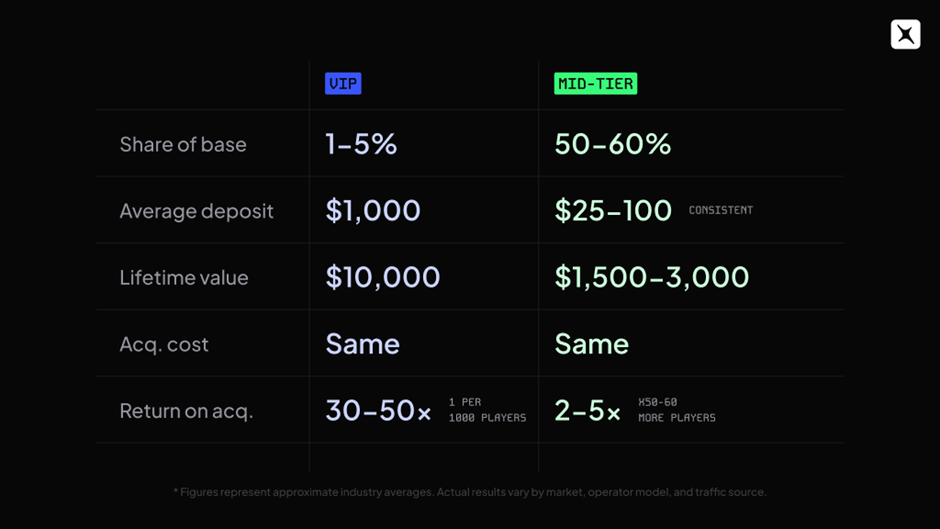
It is a user with the highest lifetime value (LTV of $10,000 or more), willing to deposit large amounts, play frequently, and remain active for months, generating returns of 30–50x the acquisition cost. The challenge is that these players are rare. To find one, operators may need to acquire hundreds or even thousands of users.
Most of those players deposit between $25 and $100, play a few times per month, and end up generating a lifetime value between $500 and $1,500. The acquisition cost remains the same, but the return typically ranges from 2–5x.
Meanwhile, there is another segment primarily looking for entertainment.
Mid-tier players represent around 50–60% of any player base. They deposit between $25 and $100 consistently over weeks or months. Rather than chasing big wins, they play for entertainment, with an LTV ranging from $1,500 to $3,000. While their acquisition cost is similar to other segments, they return more frequently and generate steady revenue. Importantly, this group is 50–60 times larger than the VIP segment.
How to Activate This Segment
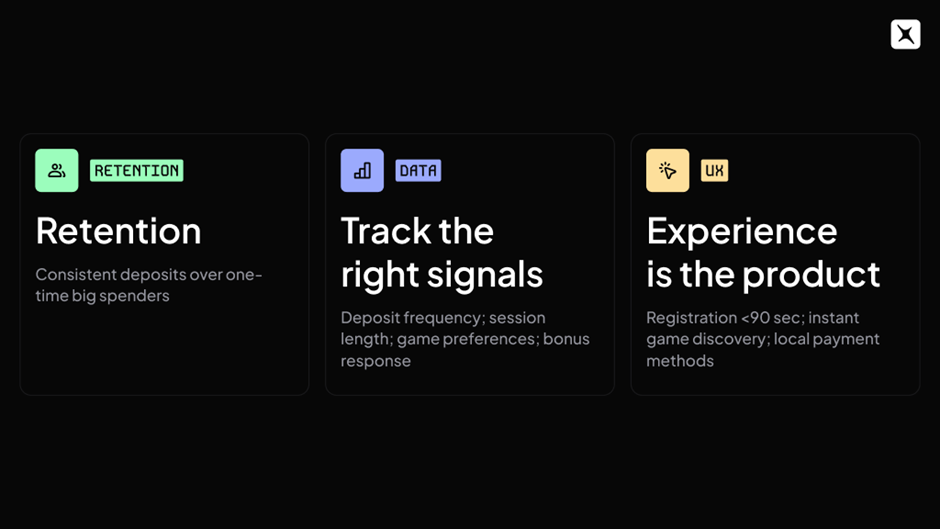
Building a strategy around mid-tier players does not mean ignoring VIPs. It means recognizing that the majority of users form the true revenue base. From TurboStar’s perspective, this requires three key shifts in approach:
Data That Works Across All Segments
Data priorities differ by player type. In VIP acquisition strategies, operators track high-potential indicators such as average bet size, deposit amounts, and early session frequency—signals that suggest whether a player is worth pursuing.
In contrast, mid-tier monetization relies on different metrics: deposit regularity, session duration, game preferences, and bonus responsiveness. The key question shifts from “Can this player become big?” to “Is this player consistent?”
Retention Mechanics for Mid-Tier Engagement
Once these behavioral patterns are understood, operators can design more relevant offers that reward not just total spend, but deposit frequency over time.
This includes:
- Bonus structures tailored to $25–100 deposits, rather than high-roller thresholds
- Offers triggered based on actual player behavior (for example, bonuses on Wednesday if the player typically deposits on Thursday)
- Game recommendations driven by real player activity, not generic promotions
- Loyalty programs that encourage consistency
UX That Doesn’t Waste Their Time
VIP players tend to tolerate certain technical complexities because they are already highly engaged. Mid-tier players, however, do not. They have options—and they use them. Any friction or неудcomfortable experience throughout the journey can lead to immediate drop-off.
This is why the experience must be seamless end-to-end. Registration should take less than 90 seconds, game discovery must be instant, and payment methods should reflect how players actually move money in each market. In many cases, the difference between a 40% and 60% conversion rate comes down to just 30 seconds of technical friction.
Conclusion
The logic is clear, as is the core idea:
Entertainment is the true product for the majority of players. Most will never become whales—and they do not need to.
Mid-tier players do not require VIP treatment. They need to feel that the platform is built for them: bonuses aligned with their spending habits, relevant game recommendations, and simple, efficient processes.
That 50–60% of users has always been there—they just have not always been the priority. Operators who understand this and reflect it in their strategies, through smart use of data, effective retention mechanics, and optimized user experience, are the ones leading growth.
This is exactly the approach TurboStar has built its platform around.