










For years, the online gambling industry has treated casino and sports betting as two entirely separate verticals. Different products, audiences, and business models made this division logical at a time when neither needed to share infrastructure or users.
Today, that reality has changed. Most operators offer both verticals under a single brand. Yet in many cases, this integration remains only skin-deep, while behind the scenes, they still operate as separate products.
This disconnect can impact revenue more than many operators realize. It is not just about better odds or bigger bonuses, but something simpler and more fundamental: how naturally players can move between verticals and whether the platform enables or interrupts that journey.
As Alex Kozachenko, CEO of Turbo Stars, explains: “Whether players prefer slots or sports betting, they come to the platform with a clear goal, whether it is entertainment, excitement, or the chance to win. The platform’s role is to make that experience as seamless as possible.”
With deep expertise in sportsbook integrations and day-to-day operations, Turbo Stars approaches cross-vertical engagement not as a promotional tactic, but as a structural product challenge.
When casino and sportsbook are designed as separate experiences, every transition becomes a potential drop-off point. But when both are part of a unified ecosystem, they reinforce each other, driving stronger retention, longer sessions, and more organic cross-sell.
From Turbo Stars’ perspective, this approach is built on three key pillars:
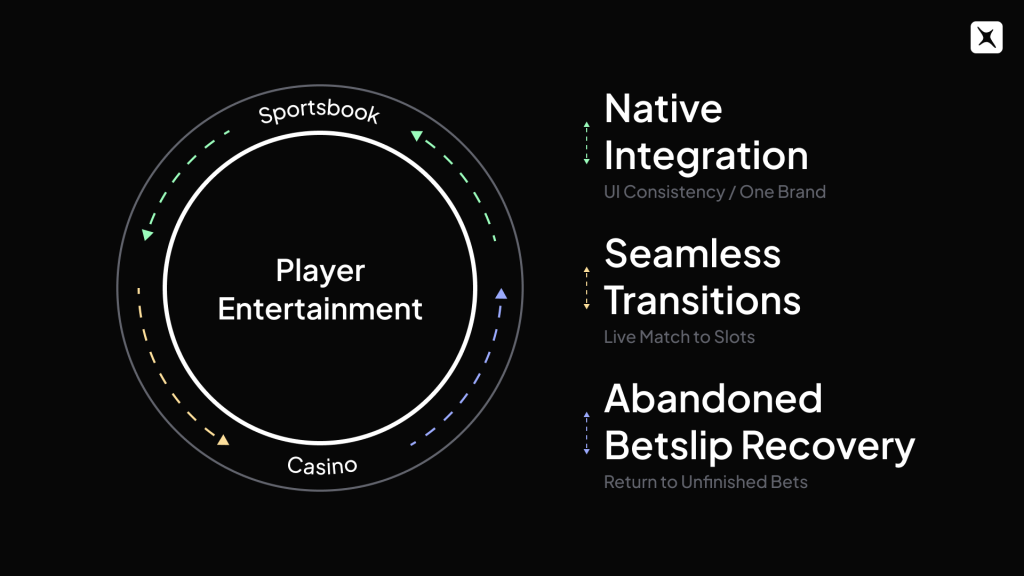
Native integration
Cross-sell only works when players feel they are staying within a single environment. If the sportsbook appears as a separate space, every transition introduces friction and uncertainty.
This can lead users to question whether they are still within the same platform, weakening trust and reducing their willingness to continue.
Seamless integration through technologies such as Shadow DOM allows the sportsbook to inherit the operator’s visual layer, including consistent navigation, familiar interaction patterns, and a unified design language.
The result is a frictionless experience where brand consistency is preserved and player trust is reinforced.
Frictionless interactions
Players do not think in verticals. They think in moments.
A user watching a live match may want to switch to slots during halftime. Likewise, a casino player may feel the impulse to place a quick bet when a major event begins.
In both cases, the intent exists but is highly sensitive to friction.
One effective solution is to remove the need to choose between verticals. For example, embedding a game window within the sportsbook allows a slot to run alongside a live event. The player can watch, bet, and play simultaneously without leaving the interface.
When transitions disappear, cross-sell stops being a tactic and becomes part of the natural flow.
As Kozachenko puts it: “It is not about the type of traffic, whether sports or casino. What matters is that wherever the player is, they can always find something valuable.”
Abandoned betslip recovery
Players often add selections to a betslip and then get distracted or postpone the decision. This does not necessarily mean lost intent, but rather an interrupted journey.
For this reason, platforms should preserve unfinished betslips and reintroduce them intelligently.
A remembered bet is far easier to complete than building a new one from scratch.
In a truly integrated environment, this becomes even more powerful. The betslip is no longer confined to the sportsbook, but follows the player across the platform. Even when switching to the casino, users can receive contextual reminders without disrupting their experience.
This ensures that player intent is maintained throughout the entire session, regardless of the vertical.
When cross-sell becomes invisible
The most effective cross-vertical strategies are rarely the most visible. They do not rely on banners, pop-ups, or aggressive incentives.
They work because the product is designed for natural flow, preserving intent, maintaining trust, and eliminating friction at every transition point.
For operators, the real opportunity lies not just in offering both casino and sportsbook under one brand, but in making them feel like a single experience.
Only then do players stop thinking in verticals and focus on what truly matters: what they want to do next.