
















The idea of a “perfect setup” sounds rational. Designing everything from scratch, eliminating dependencies and building full control over architecture, integrations, UX and bonus systems appears to be the safest path toward long-term scalability.
For large enterprise operators with established traffic and steady revenue streams, that strategy can work. When market position is already secured, investing additional time into structural precision does not necessarily threaten competitiveness.
For emerging or expanding brands, however, it can become a trap.
As a technology partner supporting operators entering regulated and emerging markets, Turbo Stars sees a clear contrast between brands that launch quickly and iterate based on live data, and those that spend months building a product the market has already outpaced by the time it goes live.
The Cost of Building Before Launching
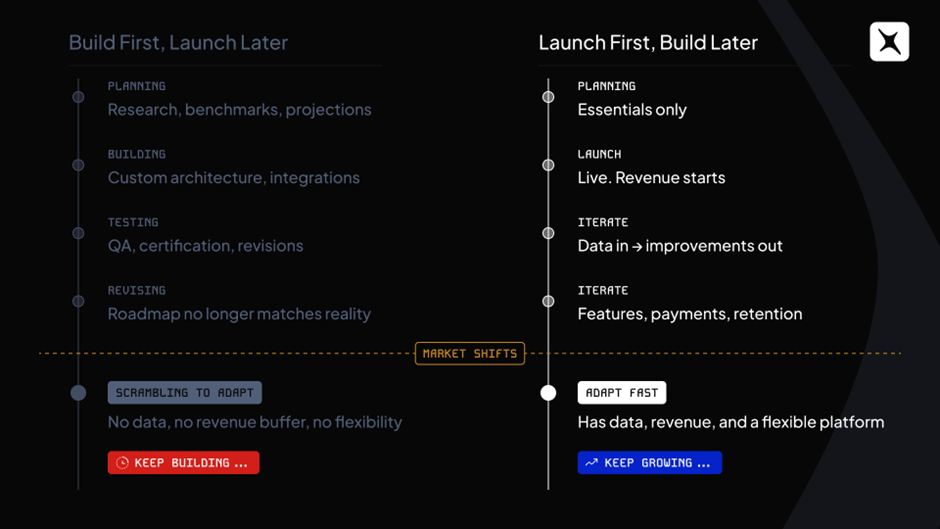
When market understanding relies primarily on research, competitor analysis and projected benchmarks, designing the “ideal” product before launch becomes a calculated gamble. Even in established jurisdictions, market conditions can shift unexpectedly.
Germany demonstrated this clearly when the Interstate Treaty on Gambling came into force in 2021, introducing a €1,000 monthly deposit cap, stricter licensing requirements and limitations on game mechanics, payments and advertising. Business models that had worked for years required structural adjustments. For operators preparing to launch, the impact was even greater, as roadmaps built on previous assumptions had to be reworked before going live, extending timelines and increasing costs.
The research was solid. The market simply did not wait.
Iterate on Real Data, Not Assumptions
True market understanding begins after launch.
Live traffic reveals what research cannot: actual player behavior, UX friction points, real bonus conversion rates and the effectiveness of retention tools. In fast-moving environments, this data becomes the only reliable compass for determining what to adjust, what to remove and where to double down.
The earlier this data starts flowing, the sooner meaningful strategic decisions can be made. This is where speed to market becomes structural.
A fast go-live triggers a virtuous cycle: revenue generation, performance analysis and rapid implementation of improvements. Each iteration sharpens the product and strengthens the overall business model.
The same principle applies when rolling out new features to an existing brand. The faster a platform can deploy functionality, the faster operators receive KPIs and performance data to evaluate impact. A delayed feature means delayed data, and delayed data means postponed decisions.
In this context, speed is not about rushing. It is about reducing the gap between decision and execution. Achieving that requires market awareness, readiness to act on insights and, most importantly, a platform capable of keeping pace.
Redefining the Perfect Setup
Does the perfect setup exist? Yes, but not as a predefined blueprint.
It is the result of accumulated real-world data, continuous iteration and a deep understanding of player behavior. It is the stage at which an operator transitions from adapting reactively to acting strategically, making confident decisions based on validated performance insights.
That is the real perfect setup: the ability to respond quickly to any market challenge, supported by a strong and flexible technological foundation.
This philosophy underpins Turbo Stars’ approach as a B2B iGaming platform and sportsbook provider focused on rapid deployment, native sportsbook integration and geo-specific localization, ensuring that the distance between identifying an opportunity and acting on it remains as short as possible.